Hi, Otherworldly Beings—
In my last entry, I discussed my learnings about the Entity from a recent playtest of Escape the Entity, the two-player game of cat-and-mouse. You can read about it below.
Escape the Entity Design Journal #3
I was recently able to get the latest build of Escape the Entity to the table for a playtest. I got a lot of good…

Now, it’s time to discuss what I’ve learned about the Puddlejumper, the ship (or mouse) that must visit four star systems before the Entity can eat one of them or reduce the trusted ship to scrap.
Fun but simple! Wait, is that a good thing or a bad thing?
The Puddlejumper uses energy to navigate this sector of space and reach its destinations. It also uses Tech Cards to help it get through tight spots.
My goal for the Puddlejumper was to make the ship feel like it was in constant danger, both due to the Entity’s powerful anomlaies and the ticking clock of the systems’ defenses failing after a certain number of turns.
I also wanted the Puddlejumper player to have a simple, straightforward play style that struck the right balance between them having decisions to make but not suffering from too much decision paralysis, as they had to deal with the ticking clock of system defenses failing.
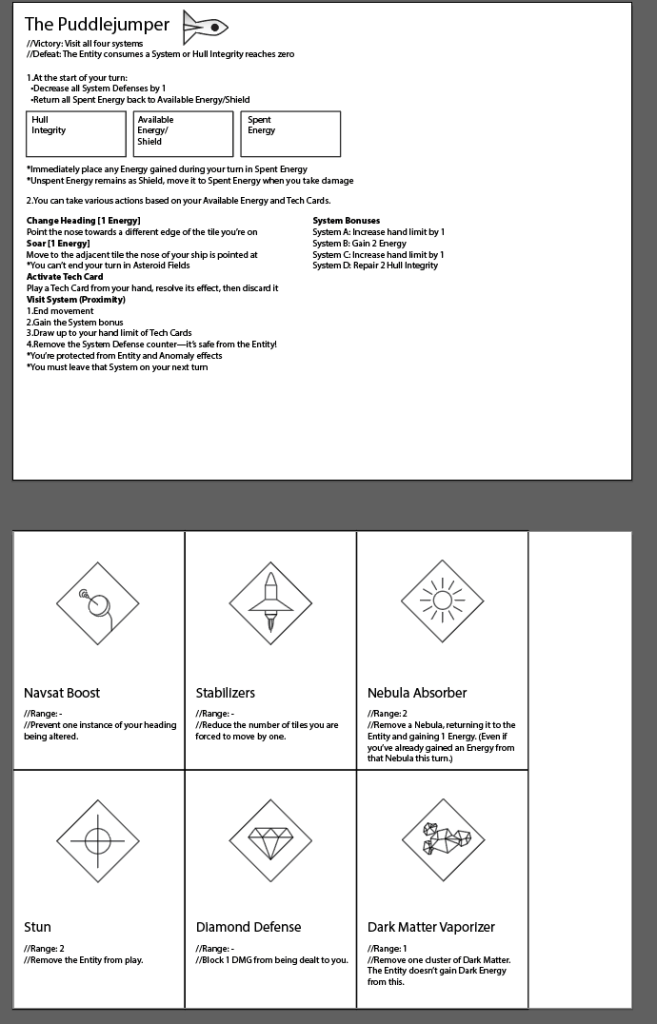
I succeeded, possibly a little too well, with the simplicity. Let’s take a look at the Puddlejumper’s play mat and Tech Cards.
Now, I want to dive into how I see the Puddlejumper evolving in the future.
The Puddlejumper’s energy and movement
The way it works
The Puddlejumper spends an energy to either change its course or move one tile in the direction it’s pointed at. Any unused energy at the end of its turn remains as shields to absorb damage.
The problem
Overall, there weren’t many issues with this system. It’s interesting and simple. The playtester did state that they may accidentally cheat and not move the correct number of cubes. That’s something for me to think on as I develop more high res assets to represent energy later on in this game’s development, but nothing for me to change right now.
One issue I see in this system is that it’s too simple. You only spend energy for travel abilities and reserve the rest for shields.
What to change
I’m likely going to give the Puddlejumper more consistent abilities that cost energy to use. This will be either alongside Tech Cards or in place of them.
The Puddlejumper’s Tech Cards
The way it works
The Puddlejumper starts with a hand of four Tech Cards which they can use as they see fit during their turn. They can use as many Tech Cards as they have, but these cards only replenish when they visit a system, so they must play them wisely.
There are six types of Tech Cards. They are quite powerful.
The problem
The strength and ease of play of the Tech Cards made for anticlimatic results which felt unbalanced for the Entity player. What I found interesting during the playtest was that the Entity player and Puddlejumper player seemed evenly matched.
We didn’t have time to play to the end of the test but we got close to an ending. It looked likely for the Entity to win, so I called it so we could move on to playing other games and make sure other designers got their chance. But as we went through feedback, the Puddlejumper player actually said they had a strategy they were going to employ to get the Entity off the back of a system it was attacking. So actually, the Entity might not have won that match.
What to change
I’m going to try a version of the game where the Puddlejumper spends energy to use abilities instead of playing Tech Cards. I liked how different the gamplay was between the two players. The Entity has more of a tempo play with a light “upgrade” system to it. The Puddlejumper has more of a quick action card play and mobility. But at the end of the day, the cards seem too easy to play and undo a lot of hard work the Entity player has to go through to build up their traps.
Systems and system bonuses
The way it works
The Puddlejumper has to visit four systems to “lock them down” from the Entity and prevent it from eating them. When the Puddlejumper visits a system, they draw up to their hand limit of Tech Cards and gain a bonus. This can be anything from increasing the hand limit to gaining more energy.
Each system has a defense value that goes down by one at the start of the Puddlejumper’s turn. The Entity can do direct damage to a system to speed up that process. When a system’s defenses reach zero, the Entity can devour that system with an attack and win the game.
The problem
One issue I found was that it seems like going for systems is the optimal strategy due to the ship’s ability to navigate so fast and the fact that systems don’t move during the game. In my last design diary entry, I talked about removing the Entity piece altogether, which will remove that as an optional win condition.
The system bonuses also have to be timed perfectly for the Puddlejumper to get maximum benefit, which will definitely take agency away from being able to plot your course.
What to change
I have a few ideas to try here. I want to try a mechanic where the Puddlejumper has to plot a course using energy cubes to make that more visible to the Entity and then loses energy when they decide to change mid-course.
I also want to turn Tech Cards into system bonus cards with a draw two, pick one element so the Puddlejumper can feel more like they get the freedom to visit whatever system they think is best without having to plot one specific course for the whole game.
How simple is too simple?
I think removing Tech Cards in lieu of System Bonus Cards, making the course plotting more visible, and giving the Puddlejumper more up front abilities to spend energy on vs just movement and shield reserve will elevate the play while still giving the Puddlejumper player a unique experience to play against the Entity.
That’s all I have for now. Time to build a new prototype and see how this all plays out.
Until next time, Otherworldly Beings…
 Mutant Pizza
Leave a comment