Happy Festivities, Otherworldly Beings—
I had a chance to playtest Existentialitis a few times and wanted to share my learnings. For details on what this game is and what my design goals are for it, check out my inaugural design journal entry on it here.
The game as it stands
Currently, the game consists of eighteen double-sided, tarot-sized cards. One side has an activity and the other a complication. You play activities in specific, semi-open patterns to deal with the current complication. Activities have four suits (and a wild), and complications ask for arrangements of said suits to be played in order to be “solved.” For example, a complication could ask for four different suits—no repeats—to be played; another, two sets of doubles. There’s a suit you’re not supposed to play and a suit you’re required to play.
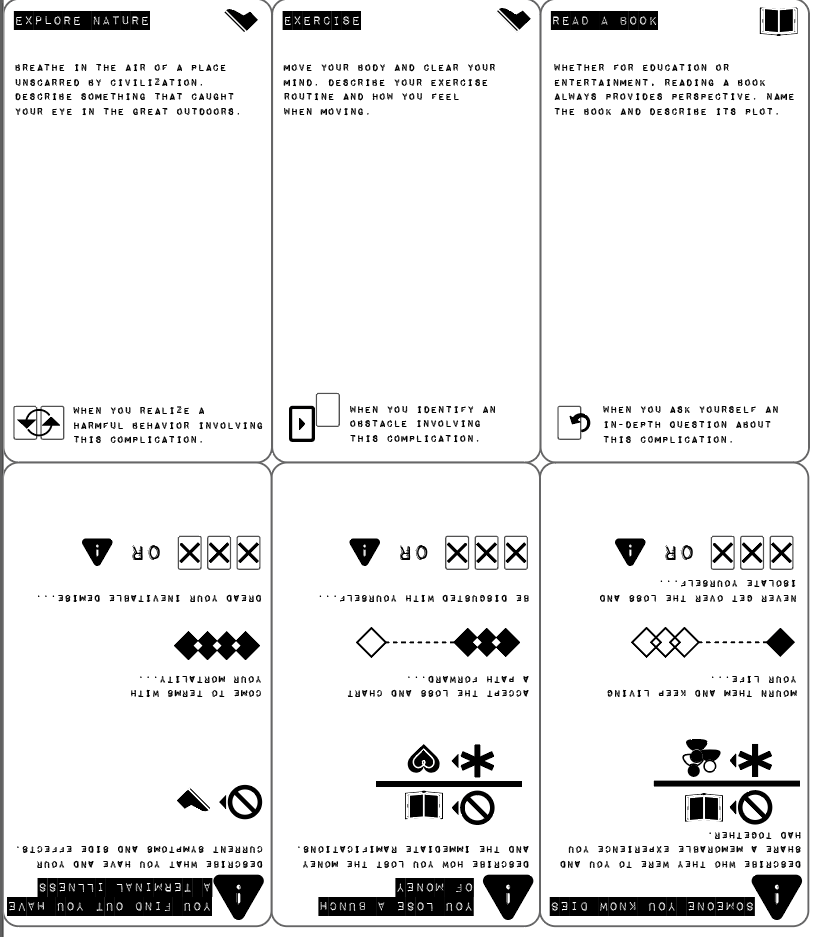
The trick is that at the end of your turn, you’re only allowed to play the leftmost card in your row. At the start of your turn, you pick a card to give to a teammate, at end of turn, you play the leftmost card and resolve its effects. Some of those effects will ask you to
When you play their cards right, you resolve the complication. When you mess up, you are “set back” and must discard the most recent card played toward the complication, taking you back a step.
There are also narrative prompts and you’re encouraged to come up with a story centered around the complications and activities. That’s one of the main things I’m going to talk about in this entry. Let’s get to it.
Here’s the feedback I got
Most of the feedback centered around the complications being too real. In one session, our complication was that we lost our job. Playtesters made up a fantasy world where we were a fox in the forest who lost our job at a peanut butter factory. (We stole that tasty spread and paid the ultimate price for it, losing our dream job.)
That sparked an idea for me. What if I made different variants of this game? A fantasy version and a science fiction version, amongst others.
In another playtest, the other player wasn’t thrilled with having to drum up a story centered around open prompts.
Another idea, what if this game had more character creation and world-building parts to it so it ended up being more of a role-playing game and less of a narrative-building game. Or at least something between the two.
Is this a role-playing or narrative-building game? What’s the difference?
When I sought to create Existentialitis, I wanted to make the game open so you could participate in as much or as little of the narrative-building portion of the game as possible. I also wanted to make a game that embraced the ups and downs of existentialist philosophy and life. The goal was to make a game where you took care of yourself properly when dealing with a crisis. I wanted the game to be one part hand-management cooperation and one part narrative-building around the margins of that. I succeeded, but while playtesting I realized that there was more I could do with this game.
Playtesters overwhelmingly think of this game as a role-playing game, not a narrative-building game. What’s the difference between those two ideas?
There is overlap, but more or less, a role-playing game is far more based on offering up various decisions and challenges and having players make compelling choices that drive a somewhat fleshed-out narrative. Narrative-building games sort of do the reverse. You’re given basic prompts for how to define a situation, and you as the player must come up with the character and the world and how all of that ties together.
In other words, a role-playing game puts you in the seat of a character in an already developed world, whereas a narrative-building game puts you in the seat of the game master who builds and runs RPG sessions.
I want Existentialitis to become a role-playing game, more focused on building things with you and for you and offering challenging decisions for you to make. I actually think I can strike a happy medium between narrative-building and role-playing that’s fun for people looking for either type of game.
One thing I’m going to do is instead of a pass/fail system for complications, I’m going to make them based more on decisions (you can choose to solve it this way or that way for different outcomes). I’m also going to add more cards for character creation and world-building, likely using a three-act structure. Act I: Define your character, your world, and your major conflict. Act II: Face challenges along the way to solving your main challenge. Act III: The big “battle” and conclusion.
I’ll get more into what this looks like in a future entry. For now, it’s time for me to get back to it.
Until next time, Otherworldly Beings…
 Mutant Pizza
Leave a comment