Hallelujah, Color Space has real tension!
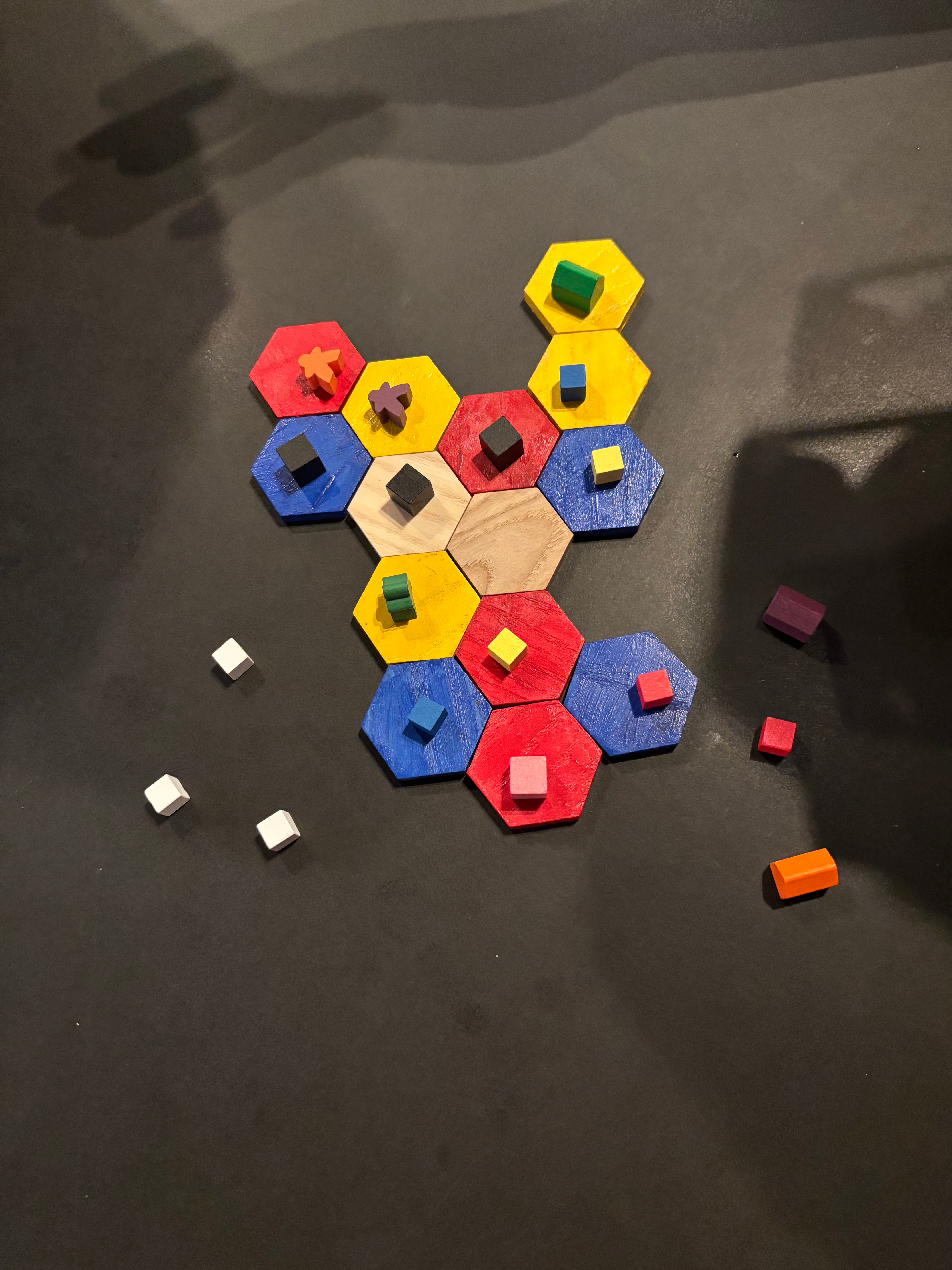
There’s something to this game. Two players, asymmetry, colors, space — it’s all coming together! I was able to get Color Space to a table in front of other designers and see how they interact with the game. The tension problems Color Space had beforehand have been effectively solved, now on to some of these nitty gritty tweaks and fine polish elements that take a game into its best version of itself.
How much complexity is too much?
That’s a good question, me. One thing I’ve come to learn is that players, even designers, will see half or less of the strategic puzzle that you see — and that’s a good thing! Trust me. It shows that a game has replayability, players know there’s more there to think about and they want to try again. But it also means that loading folks up with abilities and rules creates too much mental overhead and can deter them from wanting to experience the game.
One player, the Primary who moves the space it self!, had a lot of interactions to think about. They had many abilities to use and as such, forgot how their interactions worked on several occasions. They also kept forgetting about the swap power of the black cubes. That’s okay, I just need to reduce some of these interactions to make it a bit easier.
How much complexity is too little complexity?
Man, I’m on fire with this internalized interview today.
On the other hand, the Secondary Color alliance had too little to do, they could only move one ship at a time. I thought it’d be a fun puzzle for them to line up ships over a series of turns, having to plan ahead a bit, but it gave them too little to do. Furthermore, their move options were heavily limited as the game progressed. That’s kinda the point, but they shouldn’t be so stuck so easily that all of their moves are limited.
I need to give them more to do. Giving them more abilities might not be the right answer. (Or maybe it is, who knows? Oh, right, I’m supposed to know this, I’m the designer. Well, I don’t, so there. I’ll figure it out, okay? Just give me a moment, jeez.) I’d like to try giving them more moves to take on their turn, ratchet it up just a little for them.
Should being a troll be a player’s whole deal?
Not, like, a bridge troll, or a troll doll. The modern Internet-centric concept of a troll, without the Internet part. The Primary’s entire thing is to make moves that mess with the Secondary player, not just to get them all gunked up in space, but to prevent them from being able to make good moves on their turn. It’s like this: What if you were coming up with the rules of pool, way back when, and you decided that one player hits the stripes or solids in, like normal, but the other player is only allowed to hit the cue ball into positions that make it difficult for their opponent to make a shot. In pool, this is called a ‘safety’ and is only done when a player has no viable moves. This is a problem that I need to work out for the Primary player, it feels like all of their moves are safeties. I think that might get old quick and I need to think around it.
Gimme more of them compliments for my lil ego, baby
I was excited to hear playtesters talk about how fun the puzzle was. Designing an asymmetric game is no easy feat, and it was great to see how other people interacted with the game — as I’ve been playtesting it against myself for a while.
Both folks liked the puzzle and enjoyed the concept. There are tweaks to make to make this a truly great experience, which I always strive for, but the groundwork is there, the tension is there, and — for the most part — the game interactions are common sense.
Time to fiddle.
 Mutant Pizza
Leave a comment