Tiles and cubes and colors, oh my! Color Space is shaping up to be a fun experience, packing a lot of intrigue in a little package. Recent playtests with Color Space have proved fruitful, although there are still some kinks to work out. That’s what I want to discuss here.
Edgey edge cases
The game has suffered from ‘death by a thousand edge cases’ where there are some interactions and behaviors that make no sense, mechanically, logically, or thematically.
Sometimes, if you have a wacky exception behavior, you might be able to tie it with a thematic element to make it easier to comprehend. Not the case for Color Space.
The problem: Color Space had this behavior where some objects pushed back others, and some objects combined together to make something new, and you had to remember which objects did which and wonder why these things behaved in diametrically opposed ways. Sometimes a thing got squished, sometimes it didn’t. And it made no sense to playtesters or to me. I couldn’t figure out how to explain all of the edge cases or what the best behavior was, so I changed that whole system.
The solution: Now, instead of squishing things together, Color Space is about pushing things over the edge of the play area. More aptly put, you want to shove something off an outermost tile to collect it and use it for things.
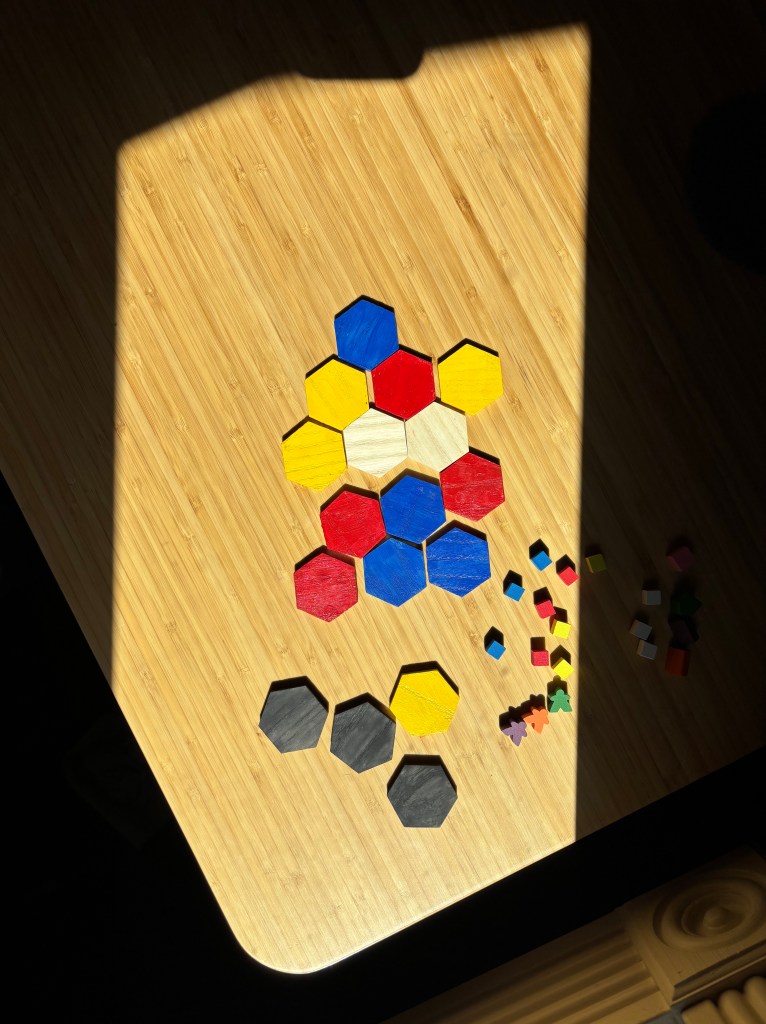
I’ve been playtesting this new fangled edgy experience and it plays so much better than the ‘squish em!’ philosophy. It’s far more common sense and allows the domino effect I want. Black hex tiles (formally black cubes) and bases can’t be pushed by either player, instead being a pass-through conduit for objects and black hexes destroying them. It makes the game experience cut and dry and logical, and most importantly easy to understand.
Balance is for suckers
One thing that I’ve noticed from playtesting the game against myself, though, is that it seems easy for the Secondary player to win. I’ve only played a handful of games and only against myself, so I’m eager to get this to a table in front of others and see if we get the same results.
Balance is an interesting beast, as game design really isn’t about this concept of ‘balance’ in that all things are equally powerful for both sides, it’s more about whether someone becoming powerful in a game feels deserved or too easy. Prior playtesting, before the new push over the edge rule, yielded favorable results for the Primary player every time. The interesting bit was that the Secondary player felt stronger because they have three ships and their movement is so nimble and adaptable, but as soon as the Primary could ramp up putting their black cubes on the board, it made gameplay far too difficult for the Secondary player. Now, with this new push over the edge mechanic, I’m finding the nimbleness of the Secondary player makes them more powerful. Watching others play will be the defacto decider on whether I need to do something to boost the Primary player’s power.
Good times
Overall, I’m thrilled with how Color Space plays now. The whole game will come in a bag and consists of tiles, cubes, meeple, and some cute lil houses. I may change this up slightly if I find something better to represent the Primary player other than a 10mm pink cube, or maybe not — we’ll see!
 Mutant Pizza
Leave a comment