Ships and hexes and bases and cubes — oh my!
Color Space is nearly complete. This game has come a long way. It started out years ago as a very different game. I love what Color Space has become. It couldn’t have gotten to this state without constant playtesting, but it was key for me to put this game on the shelf five years ago and work on other projects for a while.
Recently, I’ve been focusing on the art of the game and ordering the beautiful wooden assets for the game. I’m going to write something about the art in the future, but for now, I’d like to focus on the one piece that’s not 100% locked in, the design of the rules sheet.
I’m not going to follow your rules, maaaaan!
Formatting the information required to teach the game in a thoughtful, ocnsise manner is no small feat. It’s typically the most challenging aspect of game design. The goal here is to give you, the player, written documentation that describes all the aspcets of the game you’ll need to know to play, but organized and worded in a manner that you’ll understand.
Color Space is going to include a folded up, double-sided sheet of paper that explains the game. I’ve been working with other designers, having them perform certain actions of the game like setting it up solely by reading the steps from the document, or having them read through and teach me how to play the game.
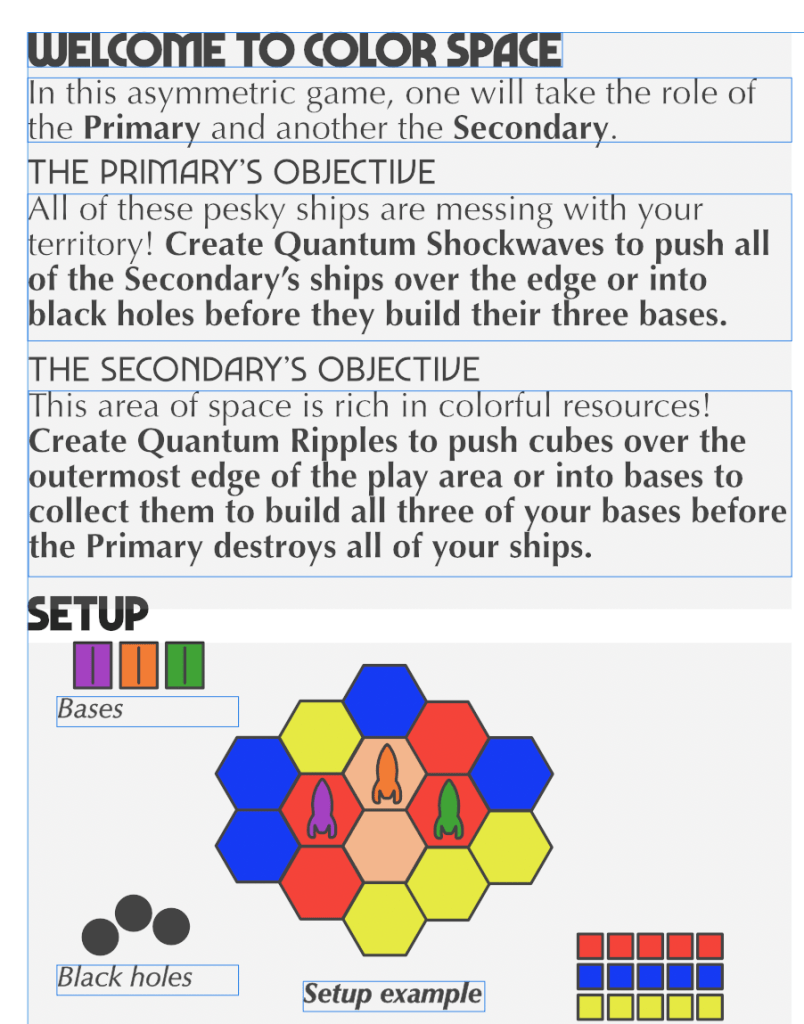
Here’s the first portion of the current iteration of the game information:
It shouldn’t be that hard to write up some rules, should it?
Color Space is unique in that it’s an asymmetric game. That means I need to use different tactics to explain how The Primary Player works versus how The Secondary Player works.
For example, a lot of the action of The Primary is in the aftermath of moving a tile. So The Primary chooses and moves a tile, with some constraints, but it’s in what happens after they’ve placed the tile that the majority of effects occur, and that’s where the bulk of their info is, as it’s very important to their strategy.
On the flip side, The Secondary takes many smaller actions that add up to something big for them. They have three ships to move and some interactions for what happens when they move to certain tiles, and that’s it. The Secondary is a bit easier to understand and they have more agility, but they’re constantly under threat and have to think more about positioning.
Because of all of this, there’s slightly different formatting to The Primary and Secondary Players’ rulesets. The Primary is more of a step-by-step, and the secondary is more of a section and subsection format.
What’s needed next to lock this sucker down?
There are some things I need to work on based on feedback from recent reviews from other designers and players, that is best served with a lovely bulleted list:
- I went wild with bolding, so I need to tone that down
- Some info needs to be ordered differently; I’ve put the cart before the horse in some areas
- Small formatting things like treating The Primary and The Secondary as ‘titles’ (maintly title casing ‘the’ like I’ve title-cased ‘Primary’ and ‘Secondary’) so they’re easier to understand
- Breaking apart some sections and putting that info elsewhere for better organization
- Minor phrase changes for clarity
Once I’ve made those edits, I’m going to make some time to playtest the game with non-designer board game players, observing what they do to ensure the game is fully functional without me there to teach it.
After that, this game will be 100% ready for the PAX indie night market!
Speaking of which…
IF YOU’RE GOING TO PAX WEST THIS YEAR, PLEASE STOP BY THE INDIE MARKET AND SUPPORT INDEPENDENT BOARD GAME MAKERS! HERE’S A FULL LIST OF ALL OF THE WONDERFUL GAMES THAT’LL BE AVAILABLE THERE: https://www.alwaysawake.games/pnw-tabletop-game-market
 Mutant Pizza
Leave a comment