Nine Muses was my debut game, I self-published it through the Game Crafter and itch.io back in 2022. I spent a year and a half working on the game. There’s a lot that goes into making a game: Creating the systems and mechanics, illustrating artwork, UI and UX design to make sure those mechanics translate well onto the assets. It was my first time experiencing all of this.
In the past three years, I’ve worked on several other games, shelved some, and un-shelved others. I’ve released another game recently, Color Space. It’s a game I took off the shelf and mixed in with a game I was currently designing at the time.
I write all of this as I take a trip back through memory lane to where it all started: Nine Muses. In this game, you compete to become the next great thinkers of your time by learning from the philosophers of Ancient Greece and calling the nine muses of antiquity for inspiration. It’s a fun little game with a limited resource pool that, when a resource (in this case, one of three types of knowledge as defined by Aristotle) is depelted, you get to steal it from your opponent.
I want to reimagine Nine Muses as a card game. Right now, it has cards and chits for resources. And I want to see if I can take the fun “stealing knowledge” mechanic in a new and interesting direction. This is what will become of Nine Muses, 2nd edition.
Oh, and I want to completely redo the art now that I have better equipment that can handle higher resolution works.
Waxing Philosophical
I was able to get an early prototype to the table twice over the past few weeks. One time with four players (I didn’t play). Another time with two players (I did play).
The framework for the game is stable! I forgot to take photos both times, so I only have a screenshot of the early design.
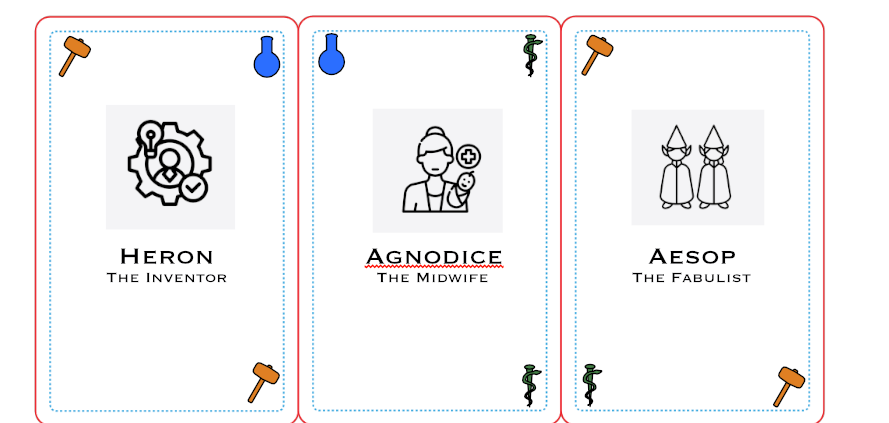
On your turn, you’ll place one of these philosopher cards in front of you to add to your study group
A few things to point out about the above screenshot:
- See those icons in the corners? Those represent three types of knowledge that you’ll need to collect in sets.
- To place a new philosopher in your study group, you’ll need to cover a symbol with a matching one. You can only place a new philosopher on top (can’t tuck it under) and you can’t change the orientation of the card.
- End game scoring is achieved by how many sets of three (hammer, flask, and Asclepius staff) you can collect by studying.
- When you play a philosopher, and an opponent has a matching card that isn’t covered, you can steal it!
In Nine Muses 1E, there were tokens and a bank. Philosophers were action cards, of sorts, allowing you to exchange or gain knowledge from the bank. When the bank was empty, you could then steal or exchange that knowledge with your opponents.
My goal with 2E is to shift this gameplay entirely to cards. I also want to ratchet up the knowledge thievery. So far, this new stealing mechanic is fun, albeit a little too random.
These mechanics are a tad tamer in a four player set up, as there are three other people for one player to steal from, so it doesn’t feel like the game is so back and forth with who’s in the lead. In a two-player setting, it’s like a tug-o-war with little mitigation factor.
Call of the Muses
Muses in 2E work similarly to how they did in 1E, there are criteria to meet for a muse to come to you and when they’re with you, you get a special power to use. This dynamic is interesting and adds a bit of counterplay, but right now there are some muses that are difficult to call, mainly due to the fact that you can’t purposefully shed any of your study group. Calliope for example requires that you have an exact number of cards in your hand and an exact number of cards in your study group.
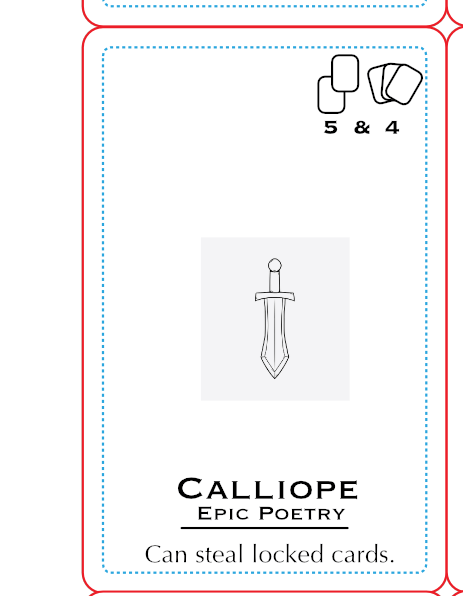
I’ve actually changed her power to be a game ender: At the start of your next turn, if Calliope is still with you, the game ends.
But the fact that you can’t just discard cards from your study group to meet her condition to come to you means that your ability to end the game is met by pure luck.
I’m rethinking the muses and their powers right now to make some of these abilities more interesting, as well as the conditions to meet to call them.
Balance for Every Player
Nine Muses 2E is still in its early stages. I have a solid framework and the theme and premise lend well to this type of gameplay. It’s been fun watching people steal philosophers and muses. One thing I’m monitoring is the gameplay length at two vs four players. The easiest thing to do here is to ask players to take a few cards out of the game during setup. I’ll probably end up marking cards for two, three, and four player counts so folks can set those aside. But for now, I’m not going to modify that until I have the base gameplay flow down pat, especially the muse abilities.
Nine Muses 2E is my Artistic Muse
Another thing I want to do is upgrade the art for the game, so I’m repainting and redrawing all of the artwork at a higher resolution. I want to share a glimpse of what the philosopher art will look like but BE WARNED, THIS IS A WORK IN PROGRESS. IT’S NOT FINISHED. STOP CRITIQUING IT IMMEDIATELY, IT’S NOT DONE. I KNOW THERE ARE SOME THINGS THAT NEED TO BE FIXED, BECAUSE IT’S NOT DONE. I’M JUST TRYING TO SHARE MY WORK IN PROGRESS ART, PLEASE, STOP PREPARING YOUR COMMENTS ABOUT HOW THIS NEED TO BE MOVED OR THAT IS TOO HIGH, OR THE SHADING IS OFF HERE. I KNOW YOU’RE ALL EXPERT ARTISTS AND BETTER THAN ME ART, OKAY? I’M NOT LOOKING FOR FEEDBACK. NO I WON’T STOP YELLING.
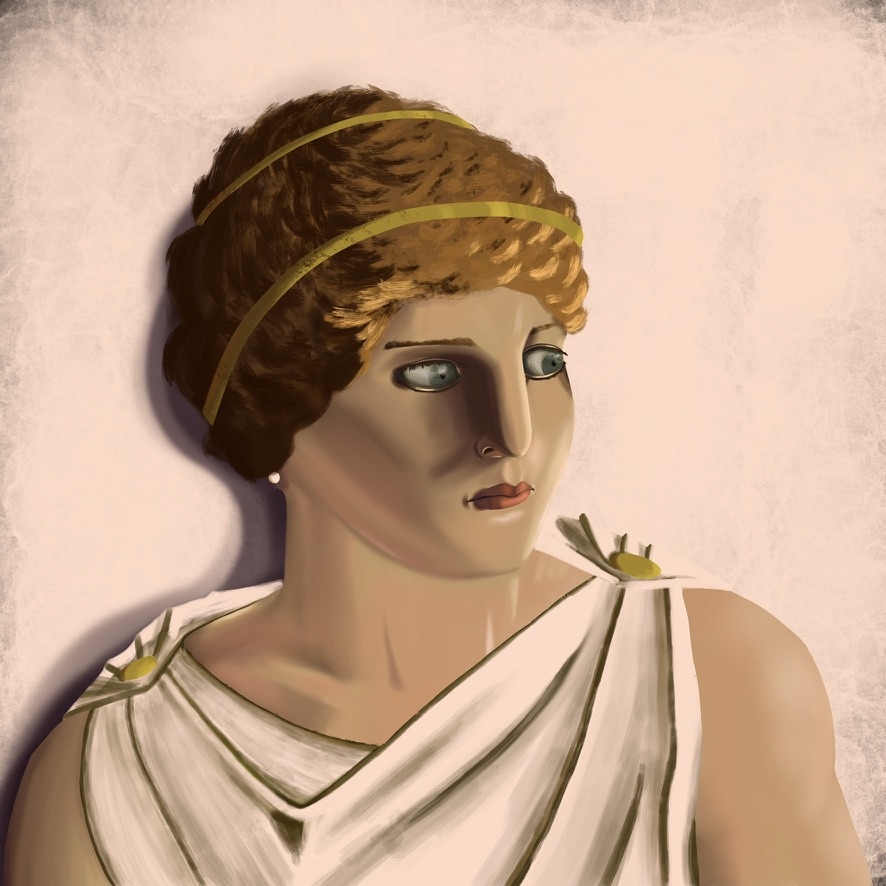
I’m not far enough along on the muse art to share anything yet, but I’ll post some works in progress soon; possibly during my next design journal entry for Nine Muses 2E.
That’s all I’ve got for now, time to get back to work on this art and these muse abilities. Until next time…
 Mutant Pizza
Leave a comment